- Grandparents
- Family stories
- Family history
50 questions to ask your grandparents while there's still time
The stories are there, in the kitchen and on the veranda, waiting for someone to ask the right way. Here are the questions, some lines to open with, and simple ways to keep what you hear.
 By JPott Studios
About a 9 minute read
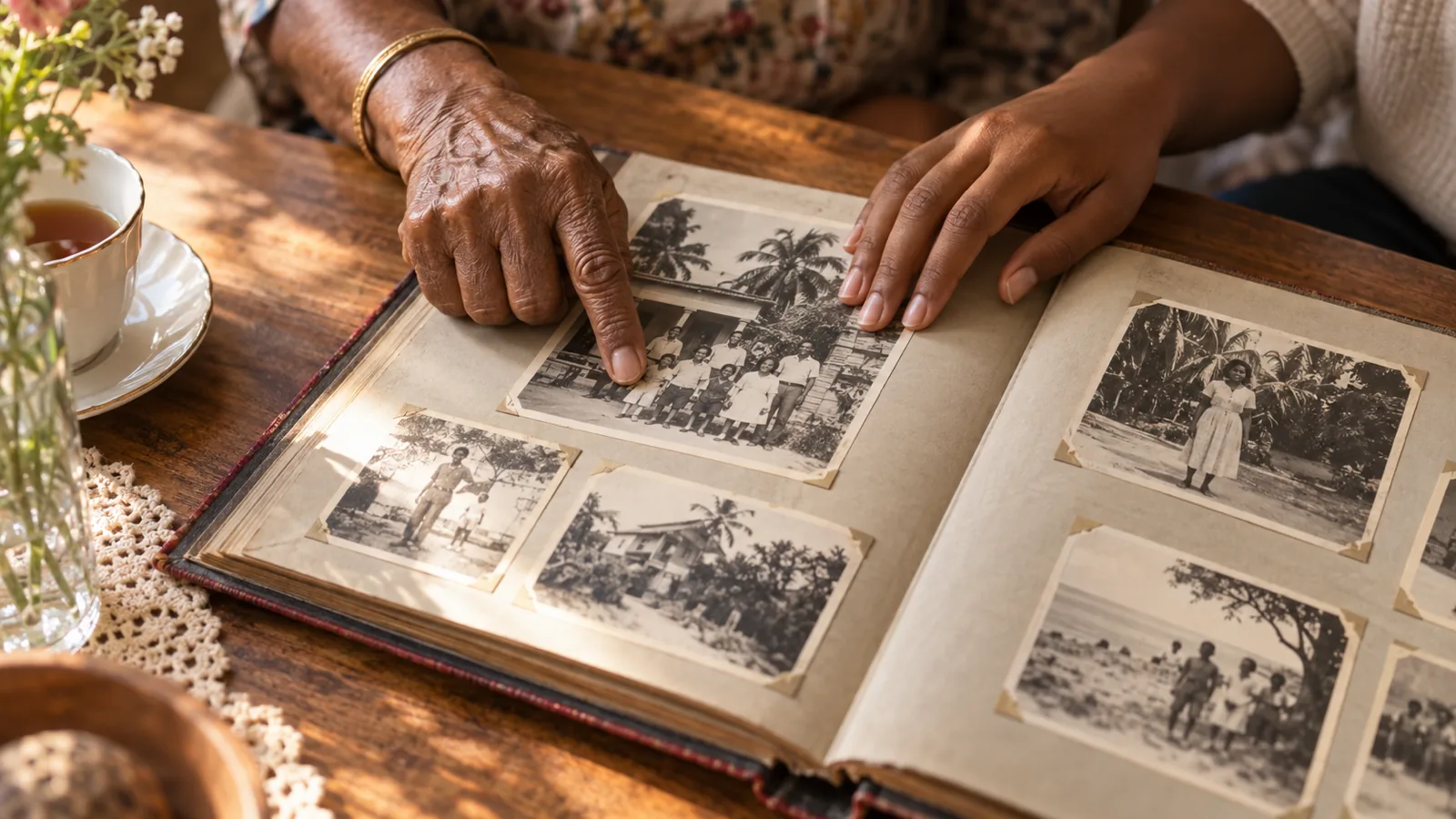
The best questions to ask your grandparents ask for one specific memory, not a summary of a whole life. “What did your kitchen smell like on a Sunday?” will get you further than “What was it like back then?”, so start with the easy, happy years and let the bigger stories come in their own time.
Below are 50 questions, grouped by the chapters of a life, written fresh for this page. You don't need all of them. Two or three good ones and a cup of tea can fill an afternoon.
What makes a good question for a grandparent?
Most of us have tried the big question and watched it fall flat. “Tell me about your life” is too much to answer on the spot. Ask about a place, an object, a smell, a person or a single day instead, and the memory has something to hold on to.
Asking isn't only for your benefit, either. In the early 2000s, the psychologists Marshall Duke and Robyn Fivush at Emory University asked children a set of 20 questions about their family, like where their grandparents grew up and how their parents met. The children who knew more of those stories tended to feel more in control of their lives and showed higher self-esteem. Family stories, it turns out, are something a family holds together.
A few habits make the questions work better:
- Ask one question, then wait. A pause of a few seconds is often where the real answer starts.
- Follow the story, not your list. If a question about school turns into a story about a cousin, go with the cousin.
- Use their words back to them. “You said the house was always full. Who else lived there?”
- Keep each visit short. Half an hour of stories is lovely. Two hours can feel like an interview.
How to start the conversation
Plenty of grandparents will say “Oh, there's nothing interesting to tell.” There always is. It helps to start small and to have something in your hands. Here are some opening lines you can borrow as they are:
- “I was trying to remember the name of the district you grew up in. Can you tell me about it?”
- “I'd love to make your curry goat one day. Will you show me, and tell me who taught you?”
- “I found this photo. Who's the one on the end?”
- “My friend asked me where our family is from, and I didn't know the whole story.”
Objects do half the work for you. Before a visit, find one of these and bring it along, or ask if they still have it:
Bring one of these, and let it do the asking
Each object comes with a first question ready to go.
- A photoOld pictures“Who took this, and what happened just after?”
- A recipeThe family dish“Who did you learn it from?”
- A songTheir old music“Where were you when this was playing?”
- A mapTheir home place“Show me where the house was.”
- A keepsakeJewellery or a watch“Who gave you this?”
- A letterCards and papers“Who wrote to you back then?”
Cooking together is one of the easiest settings of all. Hands are busy, nobody has to make eye contact, and the stories come out between the steps.
Questions about their childhood
Start here. Early memories are often the clearest and the happiest, and they warm everyone up for later.
- Can you walk me through the house you grew up in, room by room?
- What did your mother or father do all day?
- What was a normal breakfast when you were small?
- What games did you play in the yard or on the street?
- Who was your best friend as a child, and what happened to them?
- What was the naughtiest thing you ever did, and did you get caught?
- Which grown-up did you love to be around, and why?
- What did Christmas or other holidays look like in your house?
- What sounds do you remember from where you grew up?
- What did you want to be when you grew up?
Questions about school, work and first jobs
Work stories are full of detail: prices, bosses, bus routes, the first pay packet. They also show a side of your grandparent you may never have seen.
- How did you get to school, and how long did it take?
- Which teacher do you still remember, for good or bad reasons?
- How old were you when you left school, and what came next?
- What was your very first job, and what did it pay?
- What did you buy with your first wages?
- What job were you proudest of?
- Was there a job you wanted but never got to do?
- What's something that was normal at work then that would shock people now?
Questions about love, marriage and raising a family
This is often where the best stories live, and where grandparents laugh the most. Let them tell it their way, even if you've heard a version before.
- How did you meet Grandma or Grandpa? Tell me the long version.
- What did you notice about them first?
- What did a date look like when you were courting?
- What did your parents think of them at the start?
- What do you remember about your wedding day, or the day you decided to be together?
- Where was your first home together, and what was in it?
- What was my mum or dad like as a baby?
- What surprised you most about being a parent?
- What was the hardest part of raising a family then?
Questions about where your family comes from
These are the questions people most often wish they'd asked. Names, places and moves are easy to lose within one generation, especially in families that moved between countries, like the many Jamaican families who settled in England, the US and Canada.
- What were your grandparents' names, and what do you know about them?
- Where was your family from before they came to the place you grew up?
- Did anyone in the family move to another country? What did they take with them?
- What was it like the first time you left home, or the first time you travelled?
- Are there relatives we've lost touch with that I should know about?
- Which family sayings or words did you grow up with?
- Is there a family recipe, song or tradition that must not be lost?
- Which object in your home has the best story behind it?
From JPott Studios
One calm email a month
One useful tip, one free printable or tool, and a short note from our apps. Join and get the free welcome pack: printable trackers, a packing list maker and more.
Questions about hard times and big changes
Go gently here, and only when the conversation feels relaxed. Ask, then listen, and let them decide how much to say. “Would you rather not talk about that?” is always a kind thing to offer.
- What was the hardest year of your life, and what got you through it?
- What big change did you live through that you think my generation doesn't understand?
- Who helped you most when things were difficult?
- What's a decision you made that changed everything?
- Is there anything you wish you had done differently?
- What did you learn from losing someone you loved?
Questions about what they've learned
End on these. They're the ones people read again years later.
- What are you most proud of?
- What do you know now that you wish you'd known at my age?
- What made you happiest, looking back?
- What do you think makes a marriage or a friendship last?
- What's the best advice anyone ever gave you?
- What do you hope the family never forgets about you?
- What would you like to tell your great-grandchildren?
- Which of your stories do you want me to keep telling?
- Is there anything you've always wanted to be asked?
That last one is worth saving for the end of a visit. Sometimes it opens the story they've been waiting to tell.
How to keep their answers safe
Memories fade on the listener's side too. Something you're sure you'll remember is often blurry a year later, so keep what you hear, and ask first. Most grandparents are happy to be recorded once they understand it's for the family, not for the internet.
| Way to keep it | Best for | Watch out for |
|---|---|---|
| Voice recording | Their real voice, laugh and way of speaking | Label each file with the date and topic |
| A notebook | Names, dates and places spelled right | Write it up the same day, while it's fresh |
| Short videos | Recipes, songs and showing an object | Keep them brief, and save copies |
| Photo captions | Who is in each old picture | Write on the back in pencil, or keep a list |
Whatever you choose, make at least two copies and share them with a sibling or cousin, so the stories aren't all in one place. A small family group where you post one story a week can turn into something everyone looks forward to.
If you'd like help keeping it going, Our Little Thing has a Family option with one question a day, which you each answer on your own before both answers are revealed. You can pass one phone across the table, so it works even if your grandparent doesn't use apps.
What if they don't want to talk, or can't remember?
Some people are private by nature, and some memories hurt. If a grandparent brushes a question off, don't push. Try a lighter one, or come back to the subject another day with a photo in hand. Often the “no” means “not like this” rather than “never”.
If memory is getting harder for them, lean on things they can see, hear and taste: music from their teens, a familiar recipe, old photographs. Long-ago memories often stay clearer than recent ones. Keep questions simple, one at a time, and never correct the details. The feeling of the story matters more than the facts.
And if you live far apart, a phone call works too. Our ideas for staying close from a distance suit families as well as couples. For everyday table talk with the whole family, try our questions for family dinners, and for a quick one tonight, our free question of the day has a new question every day.
If your grandparents have a big wedding anniversary coming up, the stories you gather make a lovely centrepiece, and our anniversary ideas can help you plan something around them.
Asking your grandparents: common questions
What are good questions to ask grandparents about family history?
Ask for names, places and moves: their own grandparents' names, where the family lived before, and whether anyone moved to another country. Questions about a family recipe or a treasured object often lead into the history too.
How do I start a conversation with my grandparents?
Start small and specific, ideally with something in your hands, like an old photo or a recipe. “Who's this in the picture?” is much easier to answer than “Tell me about your life.”
Should I record my grandparents' stories?
If they're happy for you to, yes. Ask first, explain that it's for the family, and keep the recorder or phone out of the way. A voice recording keeps their real voice, which many families treasure later on.
What questions should I avoid asking elderly relatives?
Avoid pushing on painful subjects like loss, illness or old family fallings-out unless they bring them up. Offer an easy way out, such as “We don't have to talk about that,” and follow their lead.
How many questions should I ask in one visit?
Two or three is plenty. A good question can fill half an hour on its own, and short, regular visits tend to bring out more stories than one long session.
From JPott Studios
One calm email a month
One useful tip, one free printable or tool, and a short note from our apps. Join and get the free welcome pack: printable trackers, a packing list maker and more.